Skip to content

4.8/5.0 · 1,000+ Customers

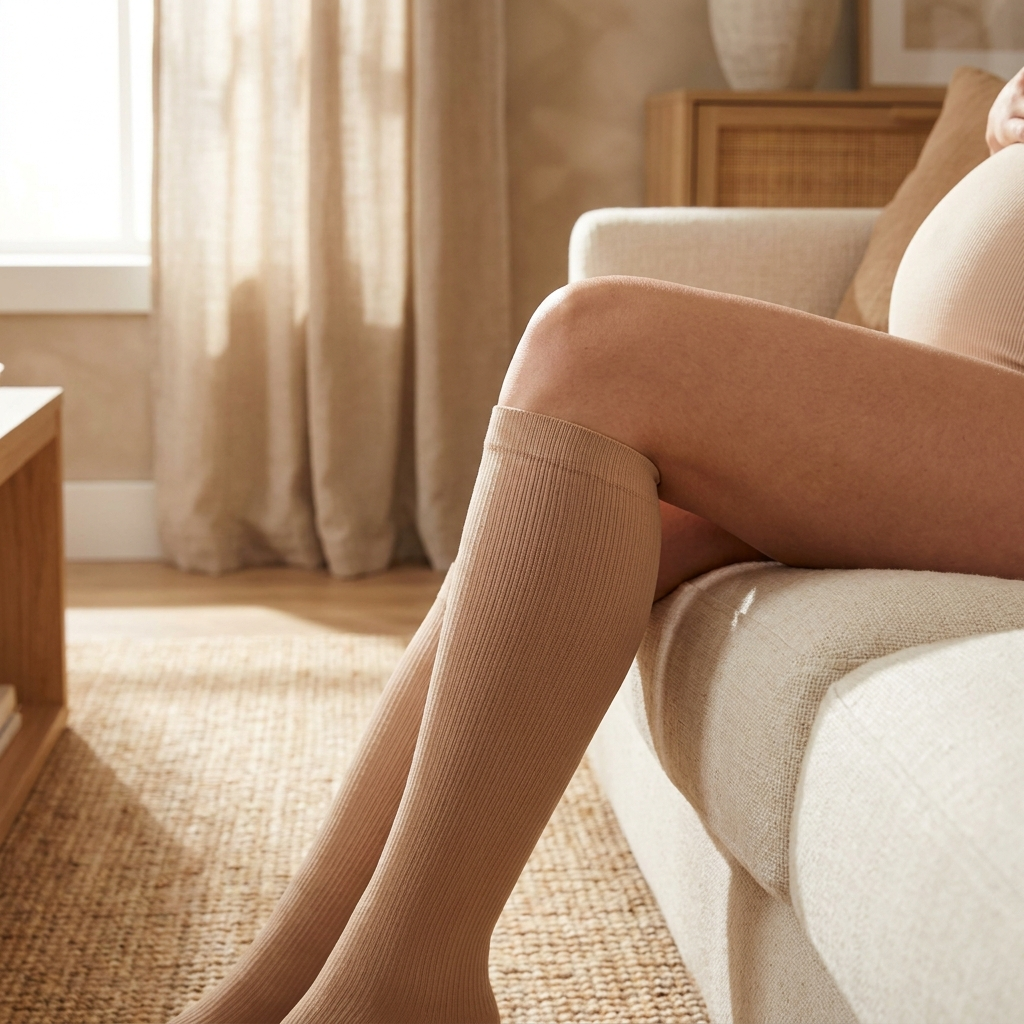
Graduated compression stockings

Graduated compression stockings

Support your legs before swelling builds.

Support your legs early in the day to help manage swelling and discomfort during pregnancy.

$53.00
  • Helps move fluid for comfort
  • Designed to stay in place
  • Supports daily swelling management
High Demand – Limited Stock Available
color: Closed toe - Beige


Size: S

Quantity :

Subtotal: $53.00

Out of stock

1
  • American Express
  • Mastercard
  • PayPal
  • Shop Pay
  • Visa

Graduated compression knee-highs made for the swelling that builds through a pregnancy day. Pressure is strongest at the ankle and eases as it moves up the calf, which supports the natural upward movement of fluid instead of letting it settle around your ankles and feet.

15–20 mmHg graduated compression — 100% at the ankle, 70% at the calf, 40% below the knee

80% nylon, 20% spandex — smooth, lightweight knit that stretches with your leg through the day

Five sizes, S to XXL — graded by calf and ankle measurement, not shoe size

Open toe or closed toe — in nude and black

Knee-high length — sits below the knee with a wide band that stays put without digging in

Orders are processed within 1–2 business days. Standard shipping takes 7–12 business days once your order ships, so most orders arrive within 8–14 business days of being placed.

If your socks don't fit, we'll send you the right size. Wear them for 30 days, if they're not working for you, we'll refund you in full.

Just email us at [shaikhcreatives08@gmail.com] and we'll sort it out.

Graduated compression stockings

Graduated compression stockings

Regular price $53.00
Sale price $53.00 Regular price $20.00
Sold out
View full details

Mornings are fine. It's the rest of the day.


It started small a little tightness by the evening. Then the rings came off, and the shoes stopped fitting. You've been told to drink more water, cut the salt, put your feet up. You've done all three. And everyone says the same thing, it's normal, it'll settle after the baby comes. They're right. That doesn't make the walk from the car any shorter or your long days any easier.

Standing less doesn't fix it. Helping the veins does.


By the third trimester, blood volume is up as much as 50%, and the uterus presses on the vena cava the main vein returning blood from the legs. Fluid leaks into the surrounding tissue and gravity keeps it there. That's why elevating helps and why it stops helping the moment you stand up. Graduated compression works on the same principle, except it doesn't ask you to lie down. Firmest at the ankle, easing toward the knee, so fluid has somewhere to go all day.

Most compression socks fail in the same four places.


Most compression socks fail in the same places. They're sized by shoe, when the pressure lands on your calf, so ours come in five sizes graded by calf measurement. They're knee high, because that's where pregnancy swelling sits, with no thigh band to roll and nothing to remove every bathroom trip. Class 1, 15–20 mmHg, firmest at the ankle enough to work, not so much you fight it all day. And while no real compression slides on like a normal sock, Class 1 is far gentler than prescription grade, so it isnt a fight to get them on each morning.

  • Correct fitting medical grade wear
  • Sized to your calf so it actually works, not just feels tight
  • Easy to slide on and off whenever you may need

Key Features for Comfort and Support

  • ANKLE

    Where the pressure starts

    Full 15-20 mmHg at the narrowest point, where fluid settles hardest by the end of the day.

  • CALF

    Eases as it moves up

    Lighter through the calf, so blood is guided upward instead of squeezed from both ends.

  • BELOW KNEE

    Lightest by design

    The top should never feel tight. That's what keeps it wearable for a full day.

What women say about support stockings

4.8 stars
Tracy C.

“Finally, a pair that doesn’t feel painfully tight”

“I had tried compression socks before and honestly gave up because one pair felt way too tight while another barely felt like it was doing anything. These feel much more comfortable and supportive. I can actually wear them for hours without constantly thinking about them.”
Maria T.

“I wish I had these earlier”

“By the afternoon my feet would get so swollen that my shoes felt uncomfortable. I started putting these on first thing in the morning, before the swelling really kicked in, and they’ve become part of my everyday pregnancy routine.”
Neveah N.

“So much easier to deal with”

“Getting compression socks on while heavily pregnant sounded like a nightmare. These are still snug, but once I learned to put them on in the morning and roll them up gradually, it became so much easier. I finally understand why people recommend compression socks during pregnancy.”
Abigal S.

“My shoes actually feel wearable again”

“I got to the point where my regular shoes were becoming really uncomfortable because my feet and ankles were so swollen by the end of the day. Wearing these earlier in the day has made my feet feel much more supported.”

Find your size

Measure your calf at its widest point and your ankle just above the bone.

Find your size
Size Calf Ankle
S 11.4–13.4 in (29–34 cm) 7.5–8.3 in (19–21 cm)
M 13.0–14.6 in (33–37 cm) 8.3–9.1 in (21–23 cm)
L 14.2–16.1 in (36–41 cm) 9.1–9.8 in (23–25 cm)
XL 15.7–17.7 in (40–45 cm) 9.8–10.6 in (25–27 cm)
XXL 17.3–18.5 in (44–47 cm) 10.6–11.4 in (27–29 cm)

Measure in the morning, before swelling builds up. If you're between sizes, go by your calf measurement.

Frequently Asked Questions

Measure the widest part of your calf first thing in the morning, before you've been on your feet. Sit with your foot flat and wrap a soft tape around it, snug but not tight. Then match your number to the chart. We size by calf, not shoe, because that's where the pressure has to land.

If you're in your second trimester or earlier, go up — your calf will keep changing. If you're in the last few weeks, go with the size your measurement lands in.

First thing in the morning, ideally before you get out of bed. Compression works best when it's on before swelling builds — once your ankles have filled up, they're harder to get on and do less.

Whenever you'd like. Some women start early as a precaution, most start when swelling first appears — usually somewhere from the second trimester on.

Yes, and it's worth planning for. Swelling often gets worse in the days after delivery before it settles, typically over one to two weeks.

Through the day, especially if you're standing, sitting for long stretches, or travelling. Take them off at night unless your provider tells you otherwise.

Class 1 compression is widely used and commonly recommended during pregnancy. Check with your provider first if you have circulation problems, diabetes, a skin condition on your legs, or a heart condition.

Orders are processed within 1–2 business days. Standard shipping takes 7–12 business days once your order ships, so most orders arrive within 8–14 business days of being placed.

If your socks don't fit, we'll send you the right size. Wear them for 30 days, if they're not working for you, we'll refund you in full.

Just email us at [shaikhcreatives08@gmail.com] and we'll sort it out.

When to call your provider

Gradual swelling in both feet and ankles worse by evening, better by morning is common in pregnancy. Some swelling is worth a same day call instead:

Sudden swelling, especially in your face or hands

Swelling in one leg only, or calf pain, warmth, or redness

A severe headache, vision changes, or pain under your ribs


Compression helps with everyday swelling. It's not a substitute for being checked.